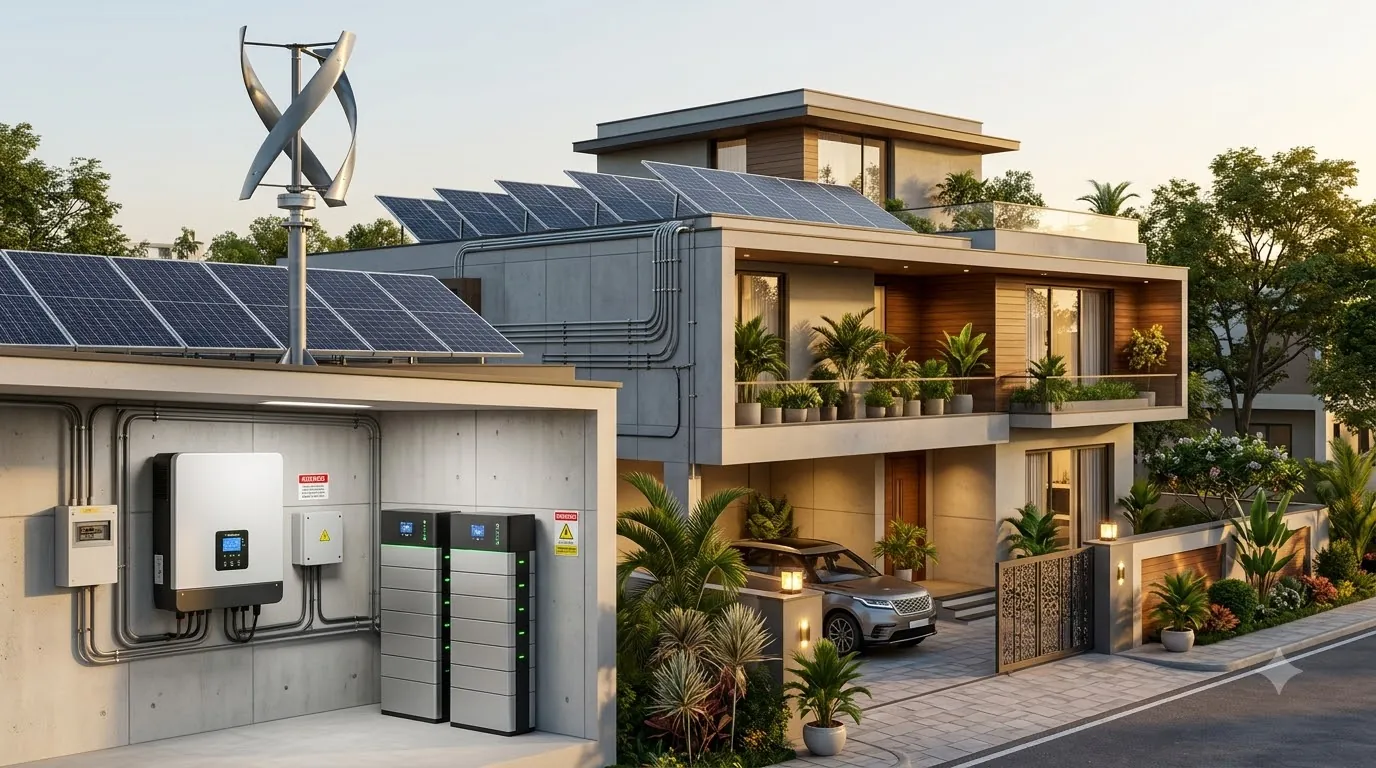
- A net meter records both the units you take from MSEDCL and the units your solar sends back.
- Solar units first cover your own consumption — that’s where the real savings are.
- Surplus units beyond your consumption are bought back at a low rate — MERC has fixed ₹2.82 per unit.
- So the smartest system is one sized close to your actual yearly consumption.
Net metering is what makes rooftop solar financially worthwhile for most homes in Maharashtra. Understanding it takes five minutes — and can save you from buying the wrong size of system.
What is net metering?
When you install a grid-connected rooftop solar system, MSEDCL replaces your normal meter with a bi-directional net meter. During the day, your home uses solar power first. If your panels produce more than you’re using at that moment, the extra flows into the grid and the meter records it as export. At night, or when your load is higher than your solar output, you draw power from the grid as usual — recorded as import.
At billing time, your exports are set off against your imports. You pay only for the net units.
A simple billing example
| Scenario (one month) | Imported | Exported | You’re billed for |
|---|---|---|---|
| Before solar | 400 units | — | 400 units |
| 3 kW solar, typical month | 260 units | 210 units | 50 net units |
| 3 kW solar, sunny month | 230 units | 250 units | 0 units (+20 surplus) |
Figures are illustrative. Fixed charges and taxes on your bill still apply, and actual numbers depend on your usage pattern and system size.
What happens to surplus units?
If, over the settlement period, you export more than you import, the extra units are surplus. The Maharashtra Electricity Regulatory Commission (MERC) has fixed ₹2.82 per unit as the rate for surplus energy injected into the grid under net metering and net billing.
That is far lower than the rate you pay per unit on a typical residential bill. In other words: every solar unit you use yourself is worth much more than a unit you export.
Net metering, net billing and gross metering
- Net metering — exports offset imports unit-for-unit; only surplus is paid at the fixed rate. This is the default for most homes.
- Net billing — imports and exports are valued separately at different rates.
- Gross metering — all generation is sold to the grid and all consumption is bought from it.
- Group / virtual net metering — lets societies or multiple connections share one system’s output. MERC has proposed expanding virtual net metering for residential consumers.
How to get a net meter from MSEDCL
- Apply online — homes applying for the subsidy do this through the PM Surya Ghar portal, which routes the application to MSEDCL.
- Technical feasibility — MSEDCL checks your sanctioned load and the capacity of your local transformer.
- Installation by a registered vendor.
- Net meter application with plant details and documents.
- Inspection, net meter installation and synchronisation — after which your system starts exporting.
MSEDCL publishes its rooftop procedures and forms on its rooftop net metering page.
Rules are evolving — what to watch
Maharashtra’s rooftop rules are under active review. In 2026 MERC published a proposed new framework for rooftop renewable energy covering net metering, net billing, group net metering, gross metering and virtual net metering — including proposals around energy storage. These are proposals until notified, so the current rules continue to apply. We’ll update this guide as the final regulations come in.
If you’re planning a system now, the safest strategy is the same either way: size for self-consumption, choose quality equipment, and work with an installer who keeps track of MSEDCL changes.
Frequently asked questions
Does net metering cost anything?
There may be application and meter-related charges as per MSEDCL’s current schedule. Your installer will tell you what applies to your connection.
Can I get paid for all the power my panels produce?
Not under net metering. Solar units first offset your own consumption; only the net surplus is paid, at the MERC-fixed rate of ₹2.82 per unit.
Will my solar work during a power cut?
A standard on-grid system shuts down during a grid outage for safety. If you need backup, choose a hybrid system with a battery.
Do housing societies get net metering?
Yes, societies can use net metering for common-area solar, and MERC has proposed broader virtual and group net metering options.
Not sure what’s right for your roof?
Book a free site visit. We’ll study your roof, your bills and your backup needs — and recommend the system that actually fits, including the subsidy paperwork.