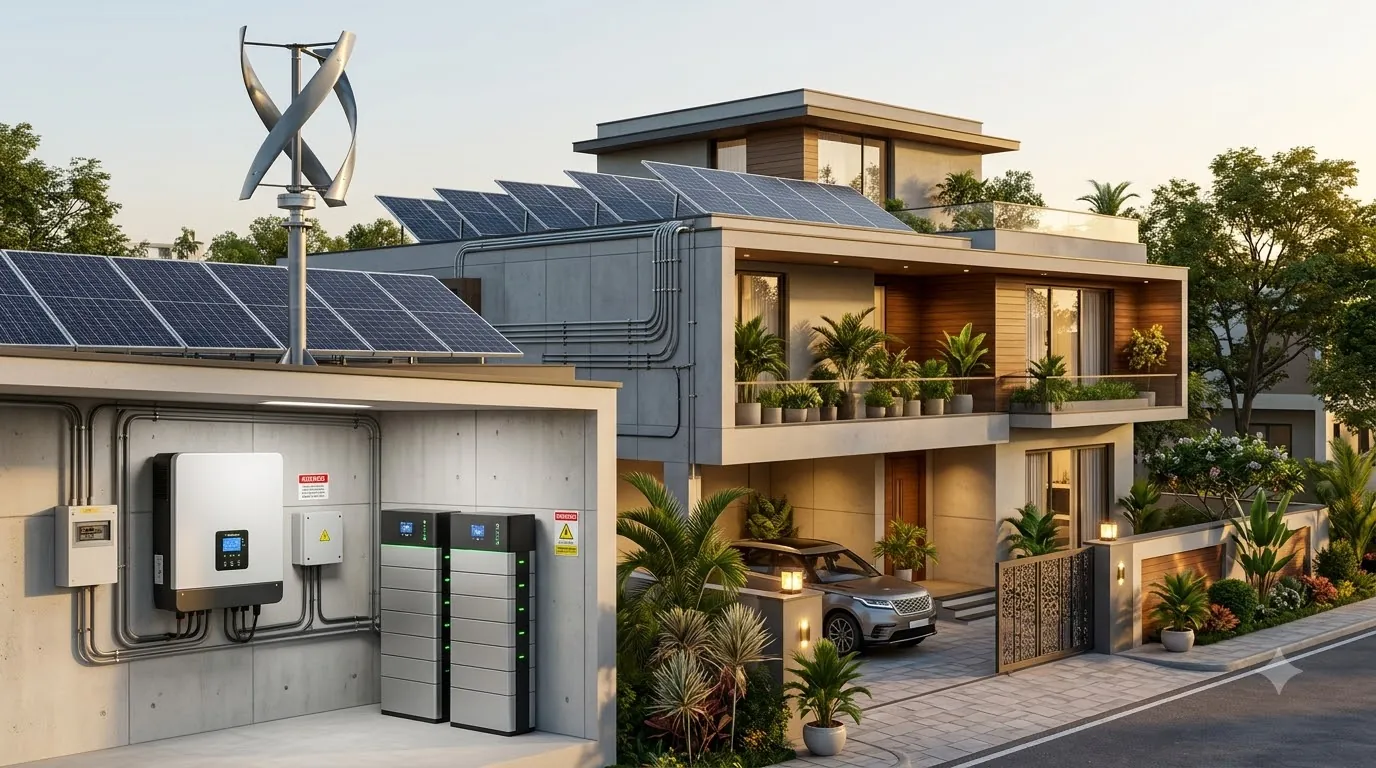
- Solar and wind complement each other: wind often picks up in the evening and during the monsoon, when solar output drops.
- Vertical-axis turbines accept wind from any direction, which suits gusty, changing rooftop conditions.
- Wind in cities is slower and more turbulent, so site assessment is everything — exposed, elevated and coastal or hilltop sites do best.
- For most homes solar remains the main source; wind adds generation and resilience.
Sunlight powers your days. But the sun sets every evening, and for three or four months of the year monsoon clouds cut solar output. Wind doesn’t follow the same schedule — which is exactly why pairing the two makes sense for the right site.
Why combine solar and wind?
A solar-only home produces nothing after sunset and much less on cloudy monsoon days. Wind is often stronger in the evenings and during the southwest monsoon along the Konkan coast and the Ghats. By adding a small turbine to a hybrid solar system, you spread your generation across more hours of the day and more months of the year — so you rely less on the grid and on your battery.
What is a vertical-axis wind turbine (VAWT)?
Most large wind turbines have three blades on a horizontal shaft that must point into the wind. A vertical-axis wind turbine spins around an upright shaft instead. That design brings real advantages for homes:
- Accepts wind from any direction — no need to turn into the wind, which suits gusty rooftops.
- Compact footprint that fits on terraces and rooftop structures.
- Heavier components sit low, close to the mounting point.
The honest part: urban wind is tricky
Wind in cities is slower and more turbulent than in open country, because buildings break smooth airflow into swirling gusts. Many traditional turbines are not designed for these low-speed (roughly 2–6 m/s), turbulent conditions. At the same time, research shows that rooftops and building edges can be windier than street level — a well-placed rooftop turbine can perform noticeably better than one tucked behind obstacles.
The takeaway: a rooftop wind turbine is not a fit for every home. Where it fits, it adds valuable generation; where it doesn’t, the same money is better spent on more solar or a bigger battery.
Is your site right for wind? A quick checklist
- Height and exposure — is your roof higher than the buildings and trees around it?
- Location — coastal, hilltop, open-farmland and lake-side sites usually have better wind than dense city centres.
- Clear wind directions — especially from the west and southwest during the monsoon.
- Structure — the roof and mounting must handle the turbine’s weight, wind loads and vibration.
- Neighbours — placement should keep noise and vibration away from living spaces.
How a solar + wind hybrid system works
- Solar panels generate during the day.
- The wind turbine generates whenever there’s enough wind — day or night — through its own controller.
- A hybrid inverter manages both sources, powers your home and charges the battery.
- The battery stores surplus for the evening and for power cuts.
- The grid, through your net meter, covers any shortfall and receives any surplus.
How VSwytch approaches wind
We start with solar — it’s the most reliable and affordable source for most homes. Then we look at your site’s height, exposure and wind direction, and at how much evening and monsoon generation you need. If wind makes sense, we design a hybrid system where the turbine, solar, inverter and battery are sized to work together. If it doesn’t, we’ll tell you so. Explore our hybrid solar + wind solutions.
Frequently asked questions
Will a rooftop wind turbine work in a city flat?
Usually only if the building is taller than its surroundings and well exposed. In dense areas, wind is often too slow and turbulent to justify a turbine.
Do vertical-axis turbines make noise?
All turbines make some noise and vibration. Good mounting and placement away from bedrooms and neighbours keep it to a minimum.
Is wind energy covered by the PM Surya Ghar subsidy?
No. The scheme’s subsidy is based on rooftop solar capacity. Wind turbines are not part of it.
Can I add a wind turbine to my existing solar system?
Often, if your inverter supports it or can be upgraded to a hybrid inverter that accepts a wind input. A site and system check comes first.
Not sure what’s right for your roof?
Book a free site visit. We’ll study your roof, your bills and your backup needs — and recommend the system that actually fits, including the subsidy paperwork.